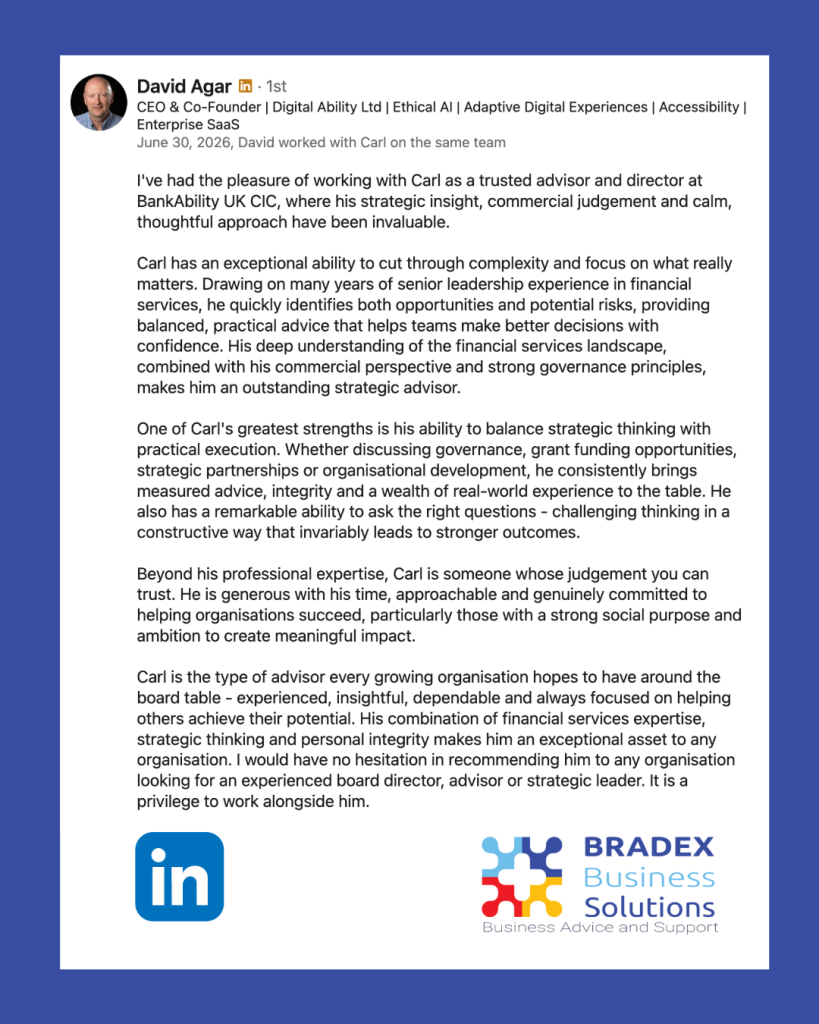
A reflection prompted by some very kind words from David Agar, CEO of DigitalAbility UK CIC.
I don’t share testimonials lightly. Not because I’m short of them, but because there’s a difference between a polite thank-you and a piece of feedback that genuinely captures the work.
This one, from David Agar, CEO and Co-Founder of DigitalAbility UK CIC, is the latter.
David and I have worked together as advisors and directors at BankAbility UK CIC, an organisation doing genuinely important work at the intersection of financial inclusion, accessibility and ethical AI. The kind of work that attracts people who care, and demands the kind of advisory support that holds up under real pressure.
Here’s what David wrote:
“I’ve had the pleasure of working with Carl as a trusted advisor and director at BankAbility UK CIC, where his strategic insight, commercial judgement and calm, thoughtful approach have been invaluable.”
I want to unpack that because I think it points to something that matters not just about me, but about what the right kind of advisory relationship should look like.
Strategic insight isn’t enough on its own
David describes me as someone who “quickly identifies both opportunities and potential risks, providing balanced, practical advice that helps teams make better decisions with confidence.”
The word balanced is doing a lot of work there, and it’s the one I’d want any business owner or board to hold onto when they’re thinking about who they bring into the room.
It’s relatively easy to find someone who’ll spot the opportunity. It’s also relatively easy to find someone who’ll obsess over the risk. The harder thing, the thing that actually moves organisations forward, is someone who can hold both at once, weigh them honestly, and help you make the call.
That’s the commercial judgement David is referring to. It’s built over years, across different sectors and different types of decisions. You can’t shortcut it. But you can access it, and that’s precisely what Bradex Business Solutions is designed to offer.
The right question beats the right answer
There’s a line in David’s recommendation that I keep coming back to:
“He also has a remarkable ability to ask the right questions — challenging thinking in a constructive way that invariably leads to stronger outcomes.”
This is, I think, the single most important thing I do in any coaching or advisory engagement.
Most boards and most senior leaders aren’t lacking in answers. They’re lacking in the right questions being asked at the right moment before a commitment is made, before a direction becomes entrenched, before the cost of changing course becomes significant.
Good advisory isn’t about having the answers ready. It’s about earning enough trust in the room to ask the question nobody else will, and framing it in a way that helps rather than unsettles. Challenge without trust is just friction. And trust without challenge is just validation, which is comfortable, but rarely transformative.
I’ve worked hard, over thirty years across financial services, consultancy and business advisory, to develop the instinct for that moment. When to push. When to listen. When to say: “Before we go any further, has anyone asked this?”
The balance between thinking and doing
David also highlights something that I believe separates genuinely useful advisory from the kind that looks good on paper:
“One of Carl’s greatest strengths is his ability to balance strategic thinking with practical execution.”
A strategy that doesn’t survive contact with a Monday morning isn’t a strategy. It’s a thought experiment.
Whether the topic is governance, grant funding, strategic partnerships, or organisational development, the goal is always the same: to arrive at a position the board or the director can act on. Not a framework that needs a consultant to interpret. Not a recommendation that raises ten more questions than it answers. Something clear, grounded, and usable.
That’s my approach. We think carefully, we challenge constructively, and we make sure the outcome is something you can take into the week.
Why this particular testimonial matters
BankAbility UK CIC occupies an interesting space; it sits at the junction of financial access, ethical technology, and social purpose. The governance challenges, the funding landscape, and the strategic decisions facing an organisation like that are genuinely complex.
To have a co-founder of David’s calibre, someone operating at the forefront of ethical AI and adaptive digital experiences, reflect in those terms on our work together is something I’m proud of.
It also reinforces something I believe deeply: that the best advisory relationships are built on mutual respect. You earn the right to challenge someone’s thinking by demonstrating that your challenge comes from understanding their situation, their constraints, and their ambition, not from a generic framework applied from a distance.
Who is this for?
If you’re a director or founder (aged 32-50) running a business in the £500k–£2m range, and you’re starting to feel the weight of decisions that need a more experienced sounding board, that’s exactly the gap Bradex Business Solutions is built to fill.
Not a fractional executive. Not a non-exec appointment in the traditional sense. A personally accountable advisory relationship, with someone who brings genuine depth in financial services, creative industry, property, and consulting, in governance, in growth strategy and who will tell you what you need to hear, not just what you’d find comfortable.
David puts it better than I could:
“Carl is the type of advisor every growing organisation hopes to have around the board table — experienced, insightful, dependable and always focused on helping others achieve their potential.”
Thank you, David. It’s been a genuine privilege working alongside you and everyone at BankAbility UK CIC. I look forward to what comes next.
If you’d like to explore what advisory support could look like for your business or organisation, I offer an introductory session at £135 — bookable via Calendly. No hard sell, no obligation. Just a straight conversation. Or call Carl directly on 0161 751 2320